
he PRCA is a contemporary and very progressive association that supports the development and regulation of the ropes challenge course and canopy tour / zip line industry. Established in 2003, the PRCA has achieved tremendous accomplishments, surrpassing other associations to become the first ANSI Accredited Standards Developer for the industry. The PRCA currently has active draft standards within the ANSI review process and public reviews are currently being conducted.
Professional Ropes Course Association - PRCA - Standards - ANSI
Showing posts with label zipline. Show all posts
Showing posts with label zipline. Show all posts
June 5, 2008
Professional Ropes Course Association - PRCA - Standards - ANSI —
January 4, 2008
Flying fox - Wikipedia, the free encyclopedia
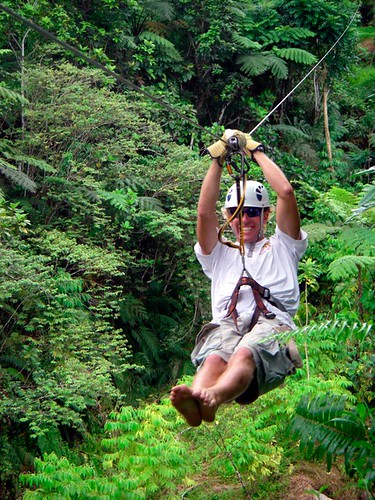
The term "flying fox" is most commonly used in reference to a small-scale zip line typically used as an item of children's play equipment, except in Australian English and New Zealand English where it also refers to professional forms of zip-line equipment.
In a flying fox the pulley(s), attached to the car, is fixed to the cable. The car itself can consist of anything from a simple hand grip, with the user hanging underneath, or a bucket for transporting small items to a quite elaborate construction, perhaps including a seat or a safety strap.
Children's versions are usually not set up with a steep incline, so the speeds are kept relatively low, negating the need for a means of stopping.
In order to be propelled by gravity, the cable needs to be on a fairly steep slope. Even then the car will generally not travel completely to the end, although this will depend on the load and some means of safely stopping the car at the bottom end is sometimes needed. It can be returned by several means, a line leading from the car to the uphill end being the simplest.
New Zealand is home to the world biggest / longest Flying Fox.
Wikipedia -Flying FoxJanuary 3, 2008
Welcome to ZIP Fiji! - Feel the rush as you soar high through the rain... | ZIP-Fiji - The newest fun adventure tour in
Welcome to ZIP Fiji!
Feel the rush as you soar high through the rain forest on the most thrilling and only canopy zip lines in the South Pacific!! A wild and fun adventure you will never forget!!
Our canopy is fully inside the jungle, located just minutes from Pacific Harbour in the beautiful and mystical mountains, maximizing your fun time on the zip lines.
Learn about and enjoy our amazing wild life and vegetation, including flying foxes, endemic birds, parrots, colourful butterflies, unique frogs, breathtaking flowers and other animals and trees you can only dream about. All at the home of ZIP Fiji.
Welcome to ZIP Fiji!
January 2, 2008
Zip-line Professional courses- Wikipedia, the free encyclopedia

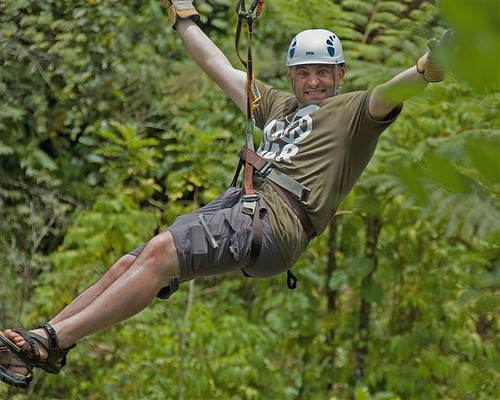
Professional versions of a zip-line are most typically used as an outdoor adventure activity. In contrast to "flying foxes" professional courses are usually operated at higher speeds covering much longer distances and sometimes at considerable heights. The users are physically attached to the cable by wearing a harness which attaches to a removable trolley. A helmet is required on almost all courses of any size.
Cables can be very high, starting at a height of over 30 feet (9 m), and traveling well over 1500 feet (457 m). All zip line cables have some degree of sag. The proper tensioning of a cable is important and allows the ability to tune the ride of a zip line.
Users of zip-lines must have means of stopping themselves. Typical mechanisms include:
- Thick purpose-built leather gloves.
- A mat or netting at the lower end of the incline.
- An arrester system comprised of springs, pulleys, counter-weights, bungee cord or other devices, which slows then stops the trolley's motion.
- Gravity stop utilizing the inherent nature of the sag in the cable. The belly of the cable is always lower than the termination point. The amount of uphill on a zip line controls the speed at which the zipist arrives at the termination point.
Costa Rica is known for their Canopy Tours where a vacationer can zip through the rainforest. The zip-lines are scattered among several platforms, some as high as 130 feet.
Zip-lines are a common way to return participants to the ground at the end of a ropes adventure course.
In past days in the Australian outback, flying foxes were occasionally used for delivering food, cigarettes or tools to people working on the other side of an obstacle such as a gully or river. Australian troops have used them to deliver food, mail and even ammunition to forward positions in several conflicts.
Zip-lines may be dangerous devices, requiring proper knowledge of ropework.
Zip-line - Wikipedia, the free encyclopedia
Subscribe to:
Posts (Atom)